PokéSurvivor beginner guide
Last updated · Unofficial fan guide · Facts checked against the official site and game source
Everything a new player needs: controls, how a run works, what the cards do, how types and weather change damage, and how to turn coins and tickets into long-term progress.
The core loop in one paragraph
A run starts with your partner Pokémon and one move. Wild Pokémon spawn around you and keep coming. You never press an attack button: the active move fires on its own cooldown, so your job is positioning. Defeated enemies drop experience; each level offers three cards. When you finally fall, the run ends and you keep the PokéCoins and tickets you earned, which you spend on permanent upgrades and on the gacha to unlock new partners. Then you go again, a bit stronger.
What PokéSurvivor looks like
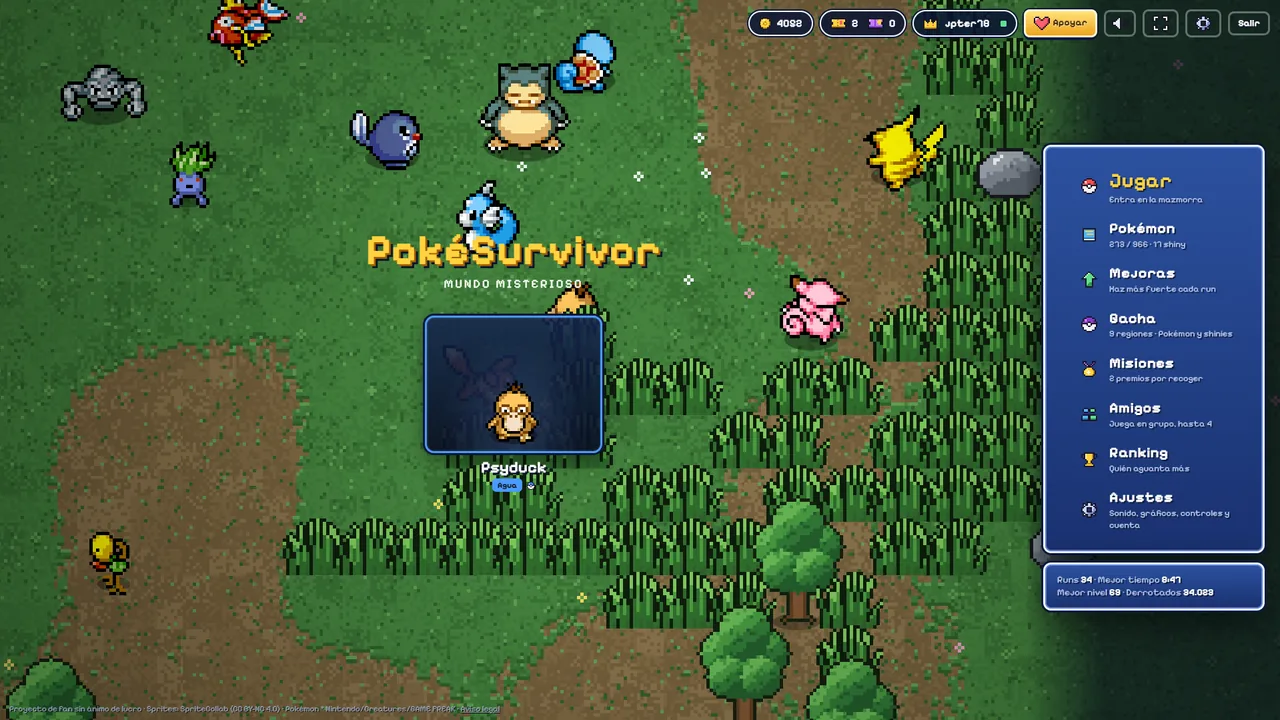


Images © their respective owners, from PokéSurvivor by JPTER78.
Controls
| Action | PC | Phone / tablet (landscape) |
|---|---|---|
| Move | W A S D or arrow keys | Drag anywhere; the joystick appears under your finger |
| Pick active move | 1, 2, 3, 4 or click the icon | Tap the move icon at the bottom |
| Cycle moves | Q / E | — |
| Pause | Esc or P | Button at the top right |
The game can be installed as an app with "Add to Home Screen". Settings include sound, graphics quality (with an automatic mode), damage numbers, reduced screen shake and an FPS counter. Music only starts after your first click, because browsers block autoplay.
Your first run, step by step
- Choose a partner. The personality quiz suggests one of the 29 starters (every region's starter trio plus Psyduck and Slowpoke). Any is fine for learning; see the tier list if you want the strongest start.
- Keep moving in wide loops. Standing still is the #1 cause of early deaths. Circling pulls the horde into a line behind you, which is ideal for projectiles, beams and sprays.
- Take a second damage source early. Your Pokémon can learn Normal moves plus the moves of its own types. An aura or orbit move protects you while you kite; a projectile or beam handles targets at range.
- Push one move to level 5. Moves upgrade from level 1 to 5. At max level, if you have taken the matching stat card during the run, a golden evolution card appears (for example Ember becomes Fire Blast after a Power card). Full list on move evolutions.
- Watch the ground. Circles and lines that fill up are telegraphed attacks. Step out before they complete.
Level-up cards
Every level gives a choice of three cards: a new move, an upgrade to a move you already have, or a boost for your Pokémon (stat cards such as Power, Vigor, Sprint, Reflexes, Armor, Synthesis, Magnet). Stat cards matter twice: they make you stronger now, and they are the keys for move evolutions. Since the 11 October update, the speed, cooldown, experience, magnet, armor and power cards can only be taken a limited number of times per run. You get one free card reroll per run and can buy more with the Card reroll upgrade.
Type chart and weather
PokéSurvivor uses the main-series type chart, softened for a game where you have one active move and cannot swap Pokémon: super effective hits deal ×1.6, not very effective ×0.6, and immunities become ×0.3 instead of zero. Dual types multiply, capped at ×2.4. The chart applies both ways, so enemy attacks on you follow it too. Practical rule: when a single-type horde shows up, switch to the move that hits it super effectively.
Weather appears from time to time:
- Rain boosts Water and weakens Fire.
- Harsh sunlight boosts Fire and weakens Water.
- Sandstorm boosts Rock, Ground and Steel; other types suffer.
- Snow boosts Ice; other types suffer and slow down.
- Fog boosts Ghost, Fairy and Psychic.
The map: terrain and objects
- Rocks, chests and tall grass can be broken.
- Walls and trees block enemy projectiles: use them as cover.
- Water slows you down (Water-type partners swim at full speed); lava burns, enemies included.
- Power altars grant boosts; springs heal you.
- Locked chests open if you stand next to them for a few seconds and are a good source of held items.
- Traps also damage enemies, so lure hordes over them.
- Occasionally a rift opens and leads to a legendary arena. See rifts & legendaries.
Enemies, bosses and events
Wild Pokémon have roles. Some heal their allies, some shield them, some summon their pack, some explode, and some fire telegraphed beams. Kill healers and shielders first or the horde becomes unmanageable. Bosses and legendaries have four telegraphed attacks, mix melee and ranged pressure, and become enraged at half health. Mid-run events include single-type hordes, a "golden hour" and lost Pokémon, and a Meowth or Gholdengo may run away loaded with coins: chase it.
Held items
Chests and bosses drop held items. You can hold only one; when you find another, you choose which to keep. Items last for the whole run.
| Item | Effect |
|---|---|
| Leftovers | Recover 1.5% of max HP per second. |
| Choice Band | +40% damage, but you cannot switch moves. |
| Quick Claw | -20% cooldown on all moves. |
| Focus Sash | A hit that would knock you out leaves you at 1 HP (once every 60 s). |
| Shell Bell | Heal from the damage you deal. |
| Amulet Coin | +50% PokéCoins at the end of the run. |
| Lucky Egg | +30% experience. |
| Life Orb | +30% damage, but each attack costs a little HP. |
| Choice Scarf | +35% movement speed. |
| Rocky Helmet | Enemies that hit you in melee take damage. |
| Assault Vest | +20% damage reduction. |
Permanent upgrades (per Pokémon)
Between runs you spend PokéCoins on upgrades. They belong to each Pokémon, so spreading coins across many partners slows you down. Commit to one or two favourites first.
| Upgrade | Effect | Max level |
|---|---|---|
| Vitality | +8 HP per level | 10 |
| Strength | +4% damage per level | 10 |
| Stride | +3% speed per level | 8 |
| Reflexes | -3% cooldown per level | 8 |
| Armor | +2% defense per level | 8 |
| Synthesis | +0.2 HP/s regen per level | 5 |
| Magnet | +12% pickup range per level | 6 |
| Wisdom | +5% experience per level | 8 |
| Fortune | +8% PokéCoins per level | 8 |
| Repertoire | Start runs with 2 moves | 1 |
| Critical Hit | +3% crit chance per level (crits deal x1.5) | 10 |
| Card reroll | +1 level-up card reroll per run | 5 |
| Ban | Block 1 move from appearing in your cards | 3 |
Missions, achievements and saving
Each day you get three daily missions and each week two weekly ones (they reset on Spanish time). They pay tickets and coins, and are the steadiest ticket income for the gacha. The 127 achievements award medals, rewards and profile titles. With an account your save syncs to the cloud; if you play on two devices, collections are merged so you never lose a Pokémon or shiny.
Next: read tips & tricks, then try co-op with friends.
FAQ
How do you switch moves in PokéSurvivor?
Press 1 to 4, cycle with Q and E, or click/tap the move icon. Only the active move fires, unless you have fused moves with a bond after beating a legendary.
Does a guest account save progress?
Guests can play immediately, but the official guide says nothing is saved for guests. Create an account (name and password, or Google) to keep your collection in the cloud.
How long does a PokéSurvivor run last?
As long as you survive. Since the 12 October 2026 update, enemies get progressively stronger from minute 60 ("overtime"), so the developer expects the best runs to end around the 90-minute mark.

Ready to try it?
PokéSurvivor is free and runs in your browser. Play it on the official site so your progress, co-op and leaderboards work.